My linen closet has a dark secret. Or rather, it had one.
It was the top shelf. The “guest” shelf. Home to a giant, fluffy king-sized comforter, two extra pillows, and a set of winter-weight flannel sheets. It was less a “shelf” and more of a “compressed mass,” always threatening to avalanche. Every time I opened the door, it felt like the closet was exhaling in frustration.
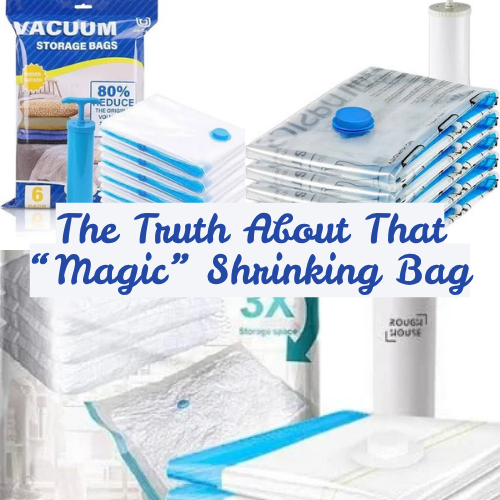
We’ve all seen the videos. Someone feeds a mountain of bedding into a plastic bag, attaches a vacuum, and whoosh—it shrinks down to a neat, flat, satisfying pancake.
The brand at the center of this magic is almost always SpaceSaver Premium Vacuum Storage Bags. They promise to triple your storage space and protect your textiles from dust, mildew, and pests.
But… does it last? Or do you come back a week later to a closet that has mysteriously, and silently, re-inflated? I dove into the real-world experiences of hundreds of users to find the honest, unvarnished truth.
What We Genuinely Love (The “Whoosh” Factor)
Let’s start with the good, because when it works, it’s so good.
The number one praise, without a doubt, is the sheer satisfaction of the “shrink.” Watching a bulky comforter or a pile of six ski jackets compress into a small, dense brick feels like a domestic superpower. For those of us with small homes, tiny closets, or a seasonal-clothing problem, this isn’t a gimmick; it’s a life-saver. It’s the difference between closing the closet door and… not.
The bags themselves, particularly from the SpaceSaver brand, are praised for being thick and durable. The plastic doesn’t feel flimsy. When you’re stuffing a lumpy pillow in, you’re not as worried that a zipper or corner is going to instantly puncture it (a common fear with cheaper brands).
The Real-World Frustrations (Let’s Be Honest)
Okay, now for the part we need to talk about. If you’ve ever used these bags, you know where this is going.
The single, most-screamed-from-the-rooftops complaint is the slow, soul-crushing leak.
You do everything right. You pack the bag, seal the double-zip, attach the vacuum, and create a perfect, flat “textile-brick.” You slide it under the bed, feeling incredibly accomplished. And then you check on it three days later, and it’s… puffy.
Here’s the hard truth we all learned: The problem is almost always user error, but the bags are incredibly unforgiving.
- The Seal: The double-zip seal must be flawless. You have to slide that little plastic clip across, and then go back over it with your fingers, pressing hard, especially at the very ends. A 1-millimeter gap that you can’t even see is all it takes for air to begin its slow, patient return.
- Overfilling: We all do it. We see the “fill line” as a “gentle suggestion.” It is not. If you stuff the bag so full that the contents are pressing against the zip, it will never hold a seal.
- The Wrinkles: This isn’t a frustration, it’s a non-negotiable trade-off. Do not, I repeat, do not store your favorite linen blazer in here. Anything you put in these bags will come out looking like a crumpled piece of paper. This is a system for fluffy things you’ll wash later (like bedding) or durable outerwear, not for your ready-to-wear wardrobe.
Oh, and that “handy travel pump” that comes in the box? Most of us agree: it’s a great forearm workout and a terrible vacuum. Use a real vacuum cleaner, always.
The Unexpected “Aha!” Moment
As I sorted through all our shared struggles, I found a few moments of pure genius.
The first is about travel. Many of us bought these for a trip, excited to pack twice as much. The problem? It doesn’t reduce weight. That’s how you end up with a carry-on that saves space but incurs a $75 overweight-luggage-fee.
Here is the real travel hack: Pack your clean clothes normally in packing cubes. Then, on your way home, use the vacuum bags for all your dirty laundry. It compresses your worn clothes (which you don’t care about wrinkling) down to nothing, contains any odors, and frees up all that new space for the souvenirs you bought. It’s brilliant.
The second “aha” was more niche. People are using these bags to protect 3D printer filament, which is notoriously sensitive to moisture. This was a huge testament to me—when you do get that perfect seal, these things are truly airtight.
My Final Reflection: Is It Worth It?
These bags are not a magic, set-it-and-forget-it solution. They are a tool that demands a little bit of precision.
But they do solve a very real, very bulky problem. They are not for your delicate clothes. They are not for things you need to access every week.
They are for the Big Stuff. They are for the seasonal swap-out. They are the tool you use twice a year to reclaim your closet from the tyranny of the guest comforter. They are for the person who is moving and needs to fit four pillows in one box.
The Verdict: Who Should Buy Them?
- A Resounding YES if: You need to store bulky, “puffy” items (comforters, pillows, ski gear) long-term. You have the patience to seal the bag meticulously. You understand this is for space-saving, not for keeping clothes wrinkle-free.
- You Might Want to Skip Them if: You get easily frustrated by things that require “a perfect seal.” You’re hoping to store everyday clothes. You think it will solve your overweight luggage problem (it will make it worse).
A final, honest tip: A common complaint about the SpaceSaver “lifetime warranty” is that it requires a number from the original packaging. We all throw that away. So, do yourself a favor: when you get your bags, take a photo of the box or cut out that little warranty code and tape it to the bag itself.
Because when you tame that top shelf, it’s a feeling of calm that’s absolutely worth the effort.