Your living room feels wrong, and you can’t figure out why. The furniture is nice. The colors are fine. But when people come over, they perch awkwardly on the edge of the sofa instead of sinking in. Conversations feel forced. You yourself avoid that beautiful armchair you bought, choosing instead to curl up in the corner of the couch every single time.
Here’s what’s happening: Your furniture might look good, but it’s ignoring something deep inside you—something older than language, older than houses, older than furniture itself. It’s called the psychology of refuge, and once you understand it, your living room will finally feel like home.
What Your Brain Wants (Even If You Don’t Know It)

Thousands of years ago, our ancestors survived by making smart choices about where to sit and rest. They needed two things at once: the ability to see danger coming (what psychologists call “prospect”) and a safe place to tuck themselves away (called “refuge”). Think of it like sitting with your back against a cave wall, facing the open landscape. You could see everything, but nothing could sneak up behind you.
Your brain still works this way. Even though there are no predators in your living room, that ancient survival instinct hasn’t gone anywhere. When your back is exposed or you can’t see the room’s entrance, your nervous system stays just a little bit on edge. You might not even notice it consciously, but your body does. Research shows that people naturally choose seats with their backs protected—against walls, in corners, or with high furniture backing them up. It’s why corner booths in restaurants fill up first. It’s why you always sit in the same spot on your couch.
This is refuge. And when your living room doesn’t offer it, you never truly relax.
The Distance That Feels Just Right

Here’s another thing most people get wrong: how far apart to place seating. Too close, and guests feel crowded, like someone’s invading their bubble. Too far, and you’re practically shouting across the room, which makes conversation feel exhausting instead of easy.
Researchers who study human behavior discovered something fascinating—there’s a sweet spot for conversation, and it’s about 4 to 8 feet apart. This distance falls into what’s called your “social zone,” the invisible circle around you where you feel comfortable talking with friends and family without feeling either trapped or distant.
When you sit 8 feet away from someone, your brain doesn’t have to work hard. You can see their face clearly. You can hear them without straining. Your voice carries naturally. Most importantly, you have just enough personal space to feel safe, but not so much that you feel alone. Interior designers call this the conversation arc, and getting it right is the difference between a room people love and a room they avoid.
If your seating is spread more than 10 feet apart, people start to feel disconnected. They raise their voices. Eye contact gets awkward. The room starts to feel more like a waiting area than a gathering place.
The Furniture Against the Wall Mistake
Walk into most living rooms and you’ll see the same thing: every piece of furniture shoved against the walls, leaving a big empty space in the middle. It seems logical—you’re making room to walk, right?
Wrong. And your nervous system knows it.
When you push all your furniture against the walls, you create what’s called a “sociofugal” space—a layout that actually pushes people apart. Researchers discovered that seating facing outward or spread far from each other discourages conversation and connection. Think of airport seating or a doctor’s waiting room. Those spaces are designed to keep people separate and quiet.
What you want instead is a “sociopetal” arrangement—furniture that gently faces inward, creating a cozy circle where people naturally gather. You don’t need the center of the room to be empty. In fact, floating your sofa a few feet away from the wall and pulling chairs closer creates something magical: a defined space that feels safe and intimate, like a nest.
Here’s the psychology: when furniture is pulled slightly inward, it creates boundaries without walls. Your brain reads this as a protected zone—a refuge within the larger room. It’s like sitting around a campfire. The furniture forms a gentle perimeter, and everything inside that circle feels like it belongs together.
Even just 12 to 18 inches of space behind your sofa can transform how a room feels. It gives the furniture room to breathe. It softens the hard edges of the walls. And it creates subtle pathways that make movement feel natural instead of forced.
The Corner Seat: Your Brain’s Favorite Spot
Pay attention next time you’re choosing where to sit. Chances are, you’ll pick a spot in the corner or at the end of the sofa—never the middle. This isn’t random. Studies on territorial behavior show that people with higher needs for personal safety and control gravitate toward what researchers call “high territorial seats”: corners, ends of rows, spots with walls nearby.
Why? Because corner seating gives you maximum refuge. You’re protected on two sides. You can see the whole room. No one can approach from behind. Your nervous system relaxes because you’re in the safest spot available.
For your living room, this means creating intentional corner zones. An armchair tucked into a corner with a side table and a lamp becomes an instant refuge—a spot people will claim and return to again and again. L-shaped sectionals work beautifully because they create a natural corner spot while wrapping people into a conversation circle.
But here’s the key: that corner seat should still face inward toward the room, not out a window or toward a wall. You want both refuge (the protected back) and prospect (the open view). When you give people both, they settle in. They stay. They talk.
How to Measure Your Living Room Like a Designer
The space between your coffee table and your sofa matters more than you think. Too close, and you’re constantly bumping your knees. Too far, and you’re stretching awkwardly to set down your drink, which makes your body tense up without you realizing it.
The magic number is 16 to 18 inches. This gives you just enough legroom to sit comfortably and stand up easily, while keeping the table close enough that reaching for it feels natural, not like a chore. This distance is based on human ergonomics—the study of how our bodies actually move and what feels good.
When you can reach your coffee table without leaning forward or stretching, your shoulders stay relaxed. When there’s enough space to cross your legs or shift position, your body doesn’t feel trapped. These tiny details add up to a room that feels right, even if you can’t explain why.
Also pay attention to walkways. You need at least 30 inches of clear space for people to move through the room without feeling like they’re navigating an obstacle course. Cramped pathways trigger low-level stress because your body has to stay alert and careful. Open, clear paths let your nervous system relax.
The Science of Why Plants Make Your Living Room Feel Safe
Here’s something that sounds almost too simple to be true: adding a plant to your living room can lower your stress hormones. But it’s not magic—it’s biology.
Researchers measured people’s cortisol levels (the main stress hormone) before and after they interacted with indoor plants. The results were striking: just being near plants, or even looking at pictures of plants, reduced stress and lowered blood pressure. Your parasympathetic nervous system—the part that helps you calm down and rest—gets activated when you’re around greenery.
Why does this work? Because your brain evolved surrounded by nature. Green, growing things signal safety. They mean water is nearby. They mean the environment is stable. Even though you’re inside a house, your ancient brain still reads those signals and responds by telling your body it’s okay to relax.
For your living room, this means adding real plants near your main seating areas. A potted plant on a side table. A small tree in the corner. Even a few succulents on a shelf. These aren’t just decorations—they’re tools that help your nervous system downshift from alert to calm.
And if you’re someone who can’t keep plants alive, don’t worry: studies found that even images of plants help reduce stress. A nature photograph or botanical print can give you some of the same benefits.
Lighting: The Element You’re Probably Getting Wrong
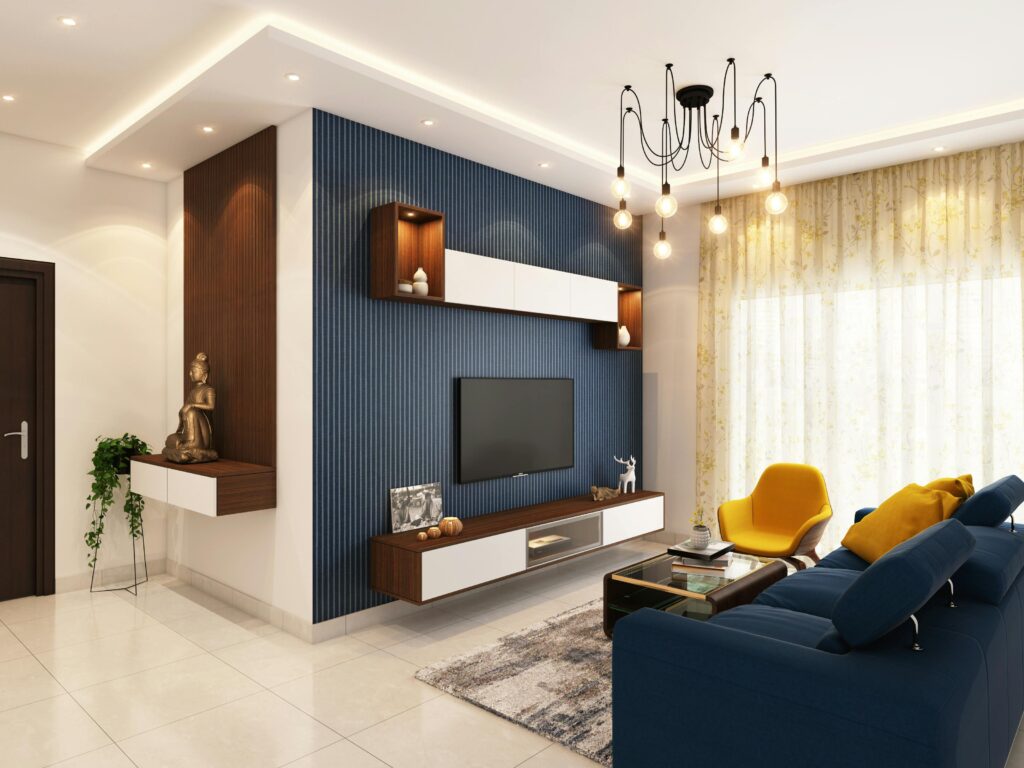
You know how some rooms feel harsh and uncomfortable while others feel soft and welcoming, even with similar furniture? The difference is often the lighting—and most people get it completely backward.
Your body has an internal clock called your circadian rhythm, and it responds to light in powerful ways. Bright, blue-toned light (the kind you get from overhead fixtures and screens) tells your brain it’s daytime. It makes you alert and focused. But it also makes it very hard to relax.
Warm, softer light—the kind that mimics sunset—does the opposite. It tells your brain that it’s time to wind down. It encourages your body to produce melatonin, the hormone that helps you rest. Research shows that warm lighting in the 2700K to 3000K range creates the cozy, calming atmosphere that makes people want to settle in and stay.
This is why so many living rooms feel uncomfortable in the evening: they’re lit like office spaces, with cool white bulbs and harsh overhead lights. Your furniture might be perfectly arranged, but the lighting is working against you, keeping your nervous system revved up when it should be calming down.
The fix is simple: use warm bulbs in your living room lamps. Add multiple light sources at different heights—a floor lamp in the corner, a table lamp next to the sofa, maybe even some soft accent lighting behind furniture. This creates layers of light that feel gentle and natural, instead of one harsh overhead source that flattens everything.
And if you can, maximize natural daylight during the day. Open your curtains. Let the sunlight in. Exposure to bright natural light during daytime hours helps regulate your sleep and mood, making you feel more energized when you need to be and more relaxed when it’s time to wind down.
Putting It All Together: Your Living Room Makeover
Let’s take everything you’ve learned and turn it into action. Here’s how to rearrange your living room to work with your psychology, not against it:
Start with your sofa. Pull it away from the wall by at least 12 inches. Position it so anyone sitting there can easily see the room’s main entrance—this gives everyone the “prospect” their brain craves. If you have an L-shaped sectional, place it in a corner to create that natural refuge spot people will gravitate toward.
Position your chairs next to or across from the sofa—not against the opposite wall. Keep them within that 4 to 8 foot conversation zone. Angle them slightly inward, toward the center of the seating arrangement. This creates a subtle circle, a protected space that invites people in.
Place your coffee table 16 to 18 inches from the sofa edge. It should be about two-thirds the length of your sofa. This keeps proportions balanced and ensures everyone can reach it without stretching.
Create a corner refuge. Pick one corner of your living room and turn it into a cozy spot. An armchair angled into the corner, a small side table within arm’s reach, a floor lamp or table lamp casting warm light, maybe a plant beside the chair. This becomes the spot where someone can curl up with a book, have their back protected, and still see the whole room.
Add living green. Even one or two well-placed plants can shift how your living room feels. Put one near the sofa or beside the corner chair. Choose something you can care for easily—a pothos, a snake plant, a small fiddle-leaf fig. The goal isn’t to create a jungle; it’s to give your brain those subtle nature cues that say “safe.”
Layer your lighting. Swap out any cool white bulbs for warm ones (2700K to 3000K). Use lamps instead of relying on overhead lighting, especially in the evening. If you can add a dimmer switch, even better—you can adjust the light level to match the time of day and the mood you want to create.
Leave clear pathways. Make sure there’s at least 30 inches of open space for people to walk through. Traffic shouldn’t cut through your seating area. Guide it around the edges, so the center stays protected and peaceful.
Pay attention to arm height on your furniture. If you like to lean against the sofa arm while you read or watch TV, make sure your furniture has arms at least 7 to 9 inches high (measured from the seat cushion to the top of the arm). Lower arms work fine if you mostly sit upright, but higher arms provide that extra feeling of being enclosed and supported.
Check your sightlines. From your sofa, can you see the door? Can people make eye contact easily from different seats? Does the arrangement feel like a circle or a cluster, rather than separate pieces scattered around? If not, pull things closer and reangle them until the space feels cohesive.
The Small Changes That Make the Biggest Difference
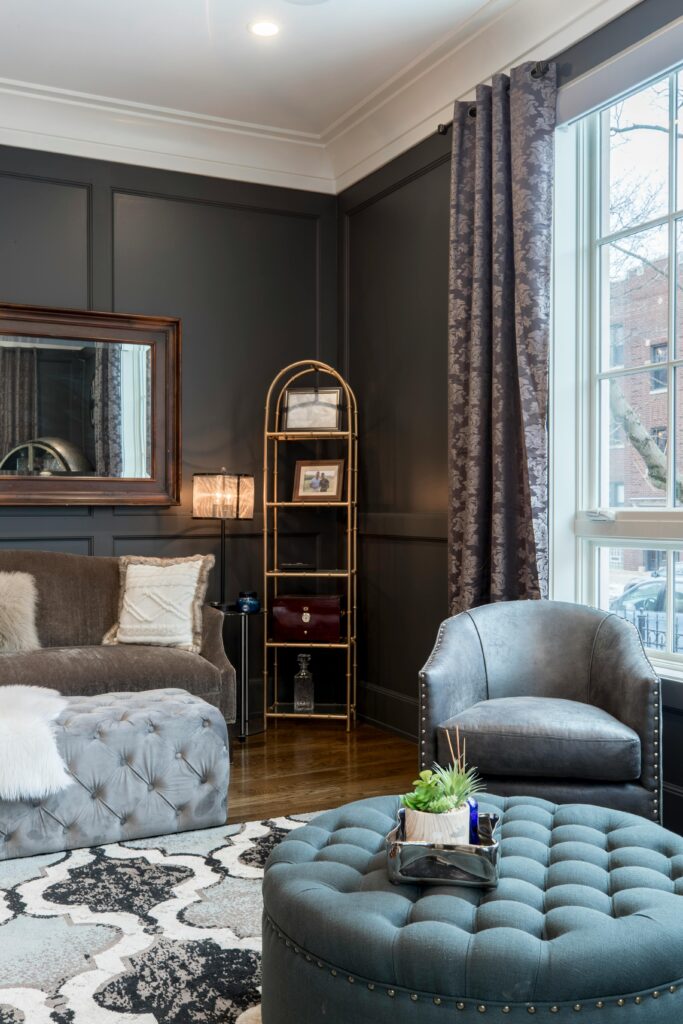
You don’t have to buy new furniture or repaint your walls to make your living room feel right. Often, it’s the tiny adjustments that matter most:
Moving your sofa 12 inches away from the wall can make the whole room feel bigger and warmer, not smaller. Turning a chair 30 degrees so it faces the sofa instead of the TV transforms a furniture showroom into a conversation space. Adding one plant brings life and calm into the room. Swapping out light bulbs changes the entire mood after sunset.
These aren’t decorating tricks. They’re adjustments that honor how your brain and body actually work. And when you stop fighting against your own psychology and start working with it, your living room becomes what it’s supposed to be: a place where you feel safe, calm, and connected.
A peaceful room creates a peaceful heart—and that’s where everything changes.
Read More: The Psychology Behind “Clutter Blindness” and How to Reset It